
“Research Experience for Teachers” is an NSF-funded program that supports summer research experiences for K-12 educators. The goal of this program is to foster relationship and the exchange of expertise between University-level researchers and K-12 educators. In other words, engineering researchers share their expertise in engineering and research with educators, and the educators help faculty understand the state-of-the-art in K-12 classrooms (curricula, pedagogy, educational environments and challenges). This program culminates in the creation of classroom activities and curricula that broaden students’ awareness of and participation in engineering career paths. Read more about this NSF initiative here.
Oakland University was recently awarded an RET site which proposed to focus on demonstrating that engineers work to make our society healthier and more sustainable. Since the metro-Detroit area is home to the automotive industry, many who live and work here conflate ‘engineering’ with designing the world’s next car. But this view is limited and engineers do much more than this! By integrating teachers in engineering research projects focused on health and sustainability and fostering the development of related classroom activities, we aim to shift the local vernacular from “engineering = automotive” to “engineering = a better world.” We believe that this shift will naturally result in increased and broadened participation in engineering careers.
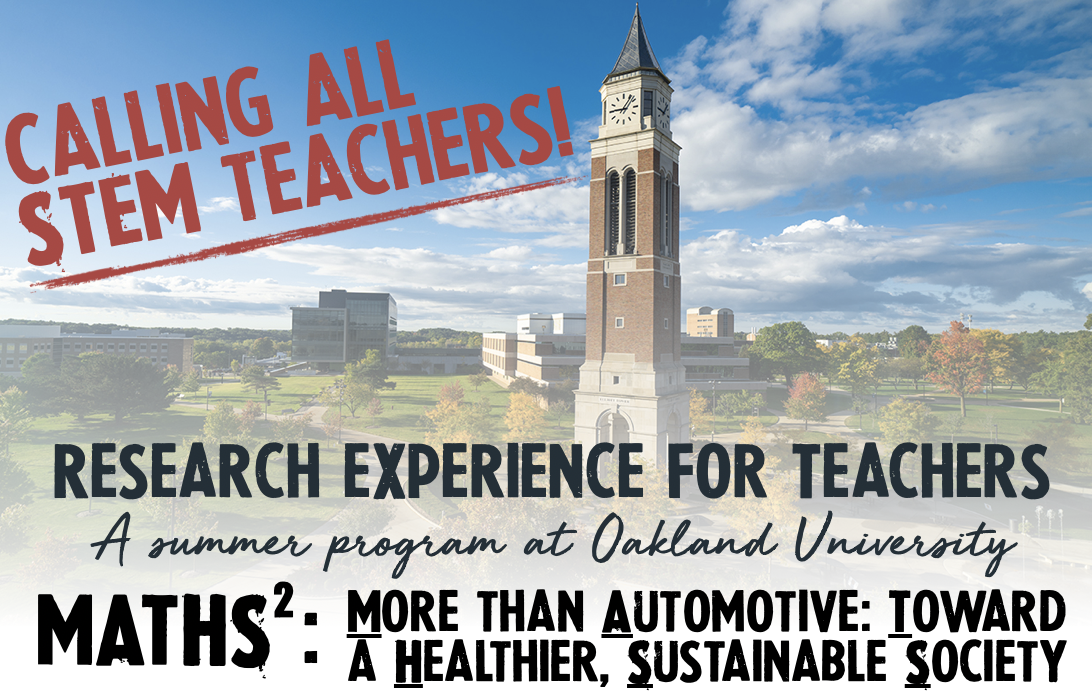
Program fast facts:
Who: This program is geared toward K-12 STEM teachers (both in-service and pre-service) in the metro-Detroit area
Successful applicants will be :
A teacher from the metro-Detroit area with a passion for science, technology, engineering and mathematics (STEM). Middle and high school level teachers should be teaching in a STEM area. Elementary teachers can teach all subjects.
In-service teachers must hold a bachelor's degree or higher in education and an active teaching or professional teaching certificate in Michigan with a minimum of a full year of teaching experience in any STEM subject at the start of the program.
Pre-service teachers must be currently enrolled in and actively pursuing a bachelor's degree in STEM education or Elementary Education with a minimum GPA of 3.0 (undergraduate and/or graduate) and have at least 50 hours of classroom time. Successful applicants will teach a STEM discipline at the K-12 level, as demonstrated by their background and courses previously taught or developed (in-service teachers) or by their coursework and extracurricular involvement (pre-service teachers). We will also take into consideration any mentorship and history for deploying new curricula to the classroom.
When: The RET program lasts for 6 weeks during the summer. In 2026, the program will begin on June 21nd and finish on August 6th, with the week of the 4th of July holiday off (July 5-9).
Where: Our program will run in a hybrid format, with about half the time spent on campus at Oakland University in Rochester, MI.
Benefits: Participants in the RET program will receive a stipend of $1800/week (in-service teachers) or $1400/week (pre-service teachers). For participants with school-aged children (K-12), OU also offers STEM-based summer camps for kids in this age range (more details can be found here).
Next steps: Applications are open from now until January 15, 2027. Please access the application by clicking the button below! Screening and interview of top applicants will occur in late January with decisions being made by the mid-February.
Application requirements:
2 letters of recommendation (For in-service teachers: One letter MUST be from your building principal.)
Resume or CV
Transcripts (graduate or undergraduate)
Responses to the following questions:
(1) Please describe your interest in the program and why you believe you are a good fit. Be sure to include comments on your interest and how you anticipate developing engaging new course curricula based on your experiences with the program, and
(2) In-service teachers: Please describe your experience teaching Science, Technology, Engineering, and/or Mathematics, including any curriculum you have developed. Pre-service teachers: Please describe your commitment to teaching science, technology, engineering, and/or mathematics in relation to your extracurricular experiences, undergraduate coursework and your post-graduation career plans.
Questions? If you have questions about the program, please contact the RET site PI (Professor Sarah Beetham, sbeetham@oakland.edu).
The 2026 RET Summer Cohort
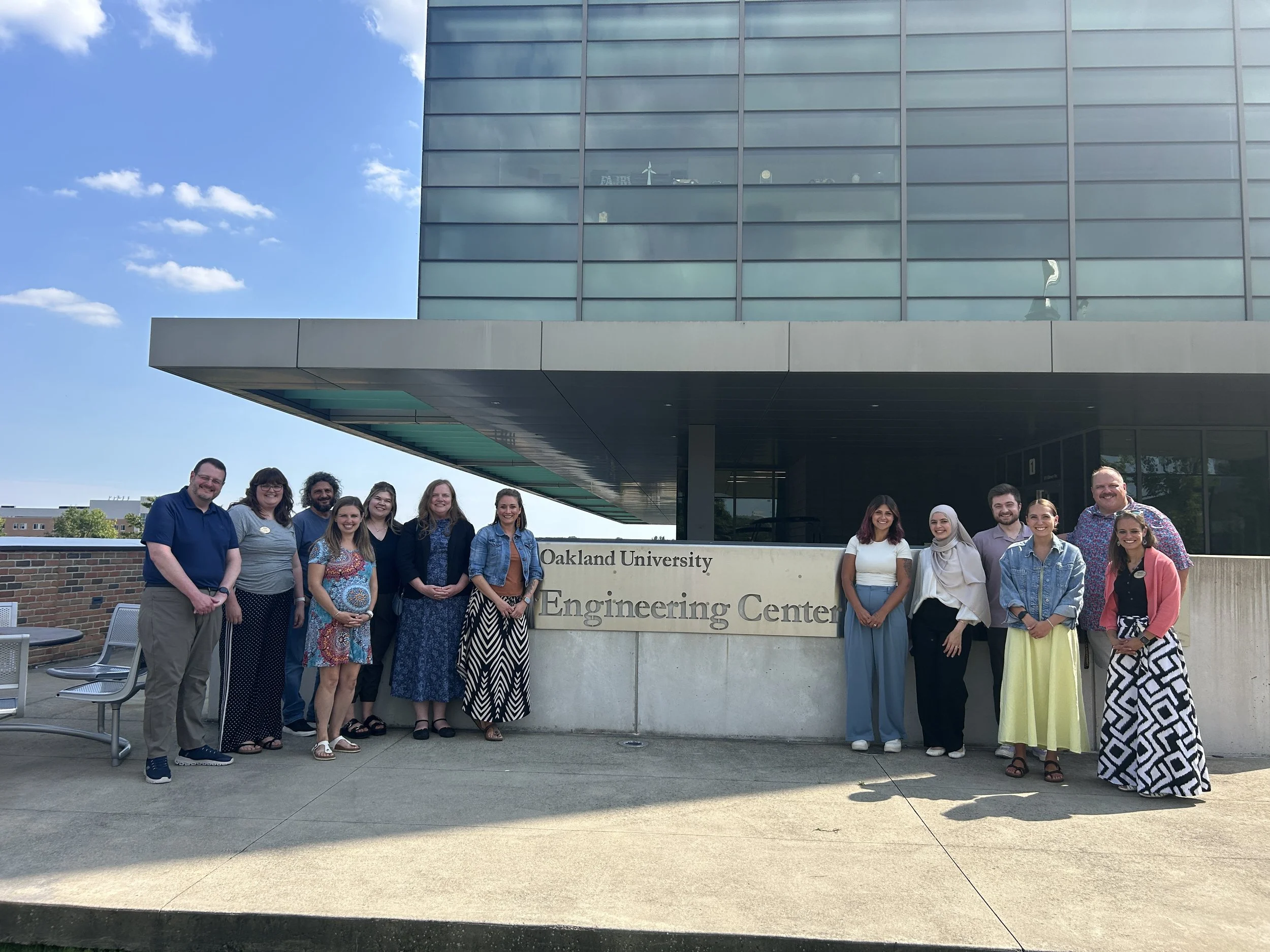
The summer 2026 cohort following the program final presentations. (Pictured from left to right)
Jason Rice (Alternative High School, Bloomfield Hills Schools), Dr. Alycen Wiacek, Kurt Ernst (Middle School, Pontiac School District), Stephanie Tunis (Elementary School, Lake Orion School District), Kennedy Ochenski (High School, Lake Orion School District), Jaime Owen (Middle School, Pontiac School District), Dr. Sarah Beetham, Vanessa Boat (OU, pre-service teacher), Raneem Alsubee (OU, pre-service teacher), Jack Siwajek (OU, pre-service teacher), Jenn Maxwell (High School, Rochester School District), Bob Smitka (High School, Roseville Community School District)
Participant Testimonials
-
As a teacher, there are times when we wish we could use our planning time for exploration, experimentation, and creation of lessons that will truly engage students beyond the prescribed curricula our districts provide. The Oakland University Research Experience for Teachers’ program, More Than Automotive: Towards A Healthier, Sustainable Society (Math2), provides you with exactly that; all while getting to work alongside engineers and fellow educators in a collaborative, paid summer experience. Through a combination of engineering lab research, engineering exploration, and education collaboration focused on the OpenSciEd framework, I was able to turn my summer into the ultimate teacher learning and planning experience.
Working in the Energy Materials Lab, investigating whether sodium could replace lithium in coin batteries, put me back in the position of a learner and a researcher, not just an instructor. I was asking questions I didn't know the answers to, troubleshooting in real time, and seeing firsthand what it actually looks like to do the kind of science I teach about. That experience alone reshaped how I think about presenting research and experimentation to my own students.
Just as valuable was the time spent with a science education professor turning that lab experience into an NGSS-aligned curriculum built on the OpenSciEd framework. Translating raw research into something classroom-ready, while trading ideas with other teachers who were doing the same thing with their own labs, pushed me to think differently about my own courses. The result, a curricular unit that engages students with the concept of renewable energy and the resources to teach it; things I wouldn’t have the time or resources to build during the school year.
Beyond the lab and the curriculum work, getting to walk through other research facilities, such as the data center and student farm, opened my eyes to fields and applications of science I don't normally get to engage with, let alone bring back to my students in Algebra 2, Environmental Science, and Microbiology. Overall, this program gave me exactly what the title promises: a broader, more sustainable way of thinking about science education, and the tools to bring that back to my classroom.
-
Participating in the RET program helped me to expand my understanding of engineering, develop my capacity to write curriculum, and provided me with a unique opportunity to combine my thinking with other STEM teachers from the metro Detroit region.
The research I conducted within the In Real Life Intelligent Robotics Lab (IRL)² at the School of Engineering and Computer Science allowed me to experience and connect to cutting edge technology research, and without a doubt enhanced my professional skills and knowledge base.
I am looking forward to implementing the curriculum I designed with my students, confident that it will help them to successfully attain specific engineering and technology standards, increase their academic competencies, and bring them joy!
-
As a third-year teacher applying for the RET program, I felt like it was right up my alley since it perfectly matched what I was already trying to do with phenomenon-based learning in my classroom. It was such an awesome opportunity to collaborate with other teachers from all over the Metro Detroit area who are doing the exact same thing at different points in their careers.
For the program, you get paired up with a partner and placed in an Oakland University engineering lab to see what professors and students are working on to help build a sustainable future. I got to work in Dr. Cepeda’s lab with his undergraduate assistant, tackling the question: How does carbon form? We used a lab reactor and iron- or nickel-based catalysts, hoping to produce carbon nanotubes through methane pyrolysis.
It was so cool to collaborate with my lab partner and turn this incredibly complex college research into a real, phenomenon-based curriculum unit for my high schoolers. I am so excited to teach this unit this school year! This program made me a better teacher, colleague, and engineer. I really hope to inspire my biology students to see that they all have a part to play in engineering a sustainable future.
Get to know more about the RET site at OU:
Meet the RET site PIs:

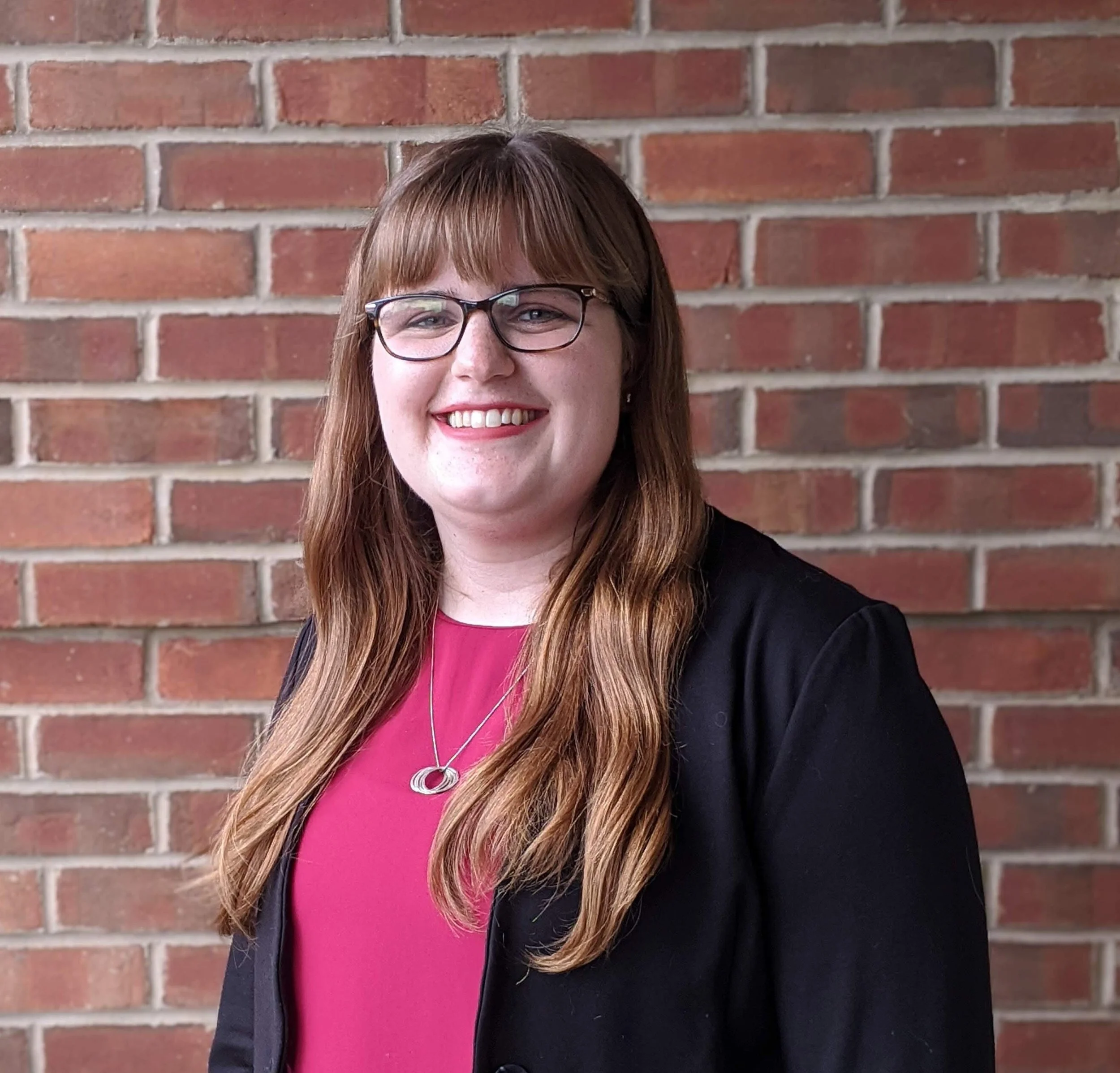


Amber Bismack, PhD
RET site co-PI
Assistant Professor of Science Education
Xia Wang, PhD
RET site co-PI
Professor & Department Chair of Mechanical Engineering
Alycen Wiacek, PhD
RET site co-PI
Assistant Professor of Electrical and Computer Engineering & Bioengineering
Sarah Beetham, PhD
RET site coordinator and PI
Assistant Professor of Mechanical Engineering
sbeetham@oakland.edu